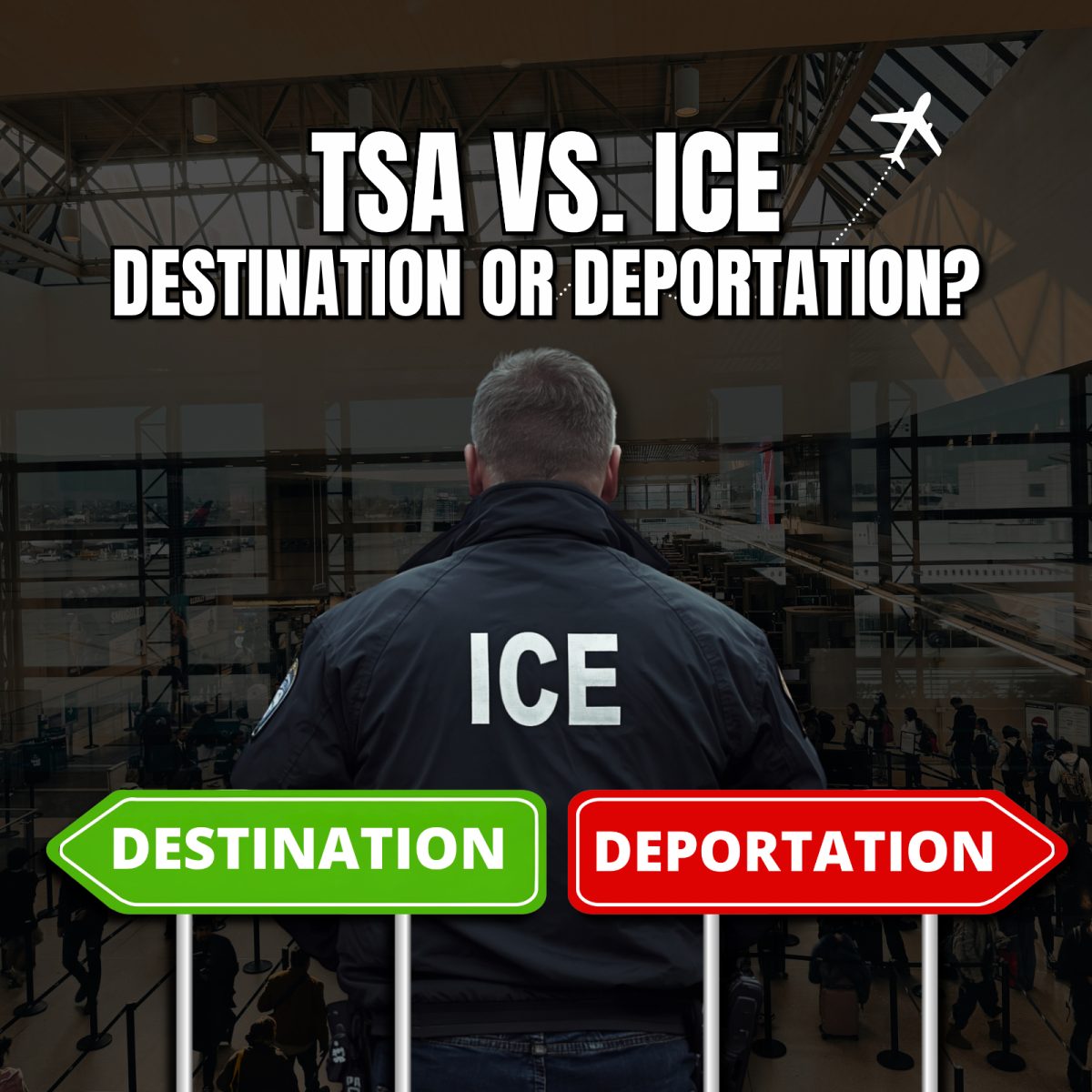
President Donald Trump dispatched Immigration and Customs Enforcement agents to airports across the United States in response to a shortage of Transportation Security Administration workers.
After the funding for the Department of Homeland and Security lapsed, TSA workers have been working without pay since February 14, 2026. Without pay, some workers do not have the means or motivation to make it to work. Over 12% of TSA workers call off daily and 480 have quit.
Airports across the country are experience lengthy lines, inaccurate estimated wait times, inefficient security checkpoints, and some airports like Hartsfield–Jackson Atlanta International Airport in Atlanta has shut down pre-check lines due to shortage of staff. On the other hand, ICE agents are still getting paid due to a separate $75 billion funding that was set aside by Congress in the summer of 2025.
According to CNN, ICE agents have been deployed to airports in major cities such as Chicago, Cleveland, Atlanta, Houston, New York, New Orleans, Puerto Rico, Newark, Philadelphia, Phoenix, Pittsburgh, and Fort Myers.
“Guarding entrances and exits, assisting with logistics, doing crowd control, and verifying identification using TSA equipment and standard operating procedures, said Lauren Bis, the Deputy Assistant Secretary for Media Relations for the Department of Homeland and Security in a statement to NPR when asked the reasoning for ICE presence at airports. Despite the relief ICE agents are intending to provide to TSA workers, evidence suggest it is beyond their qualifications to provide the help that is needed.
“Thus far, it’s basically what I expected when I heard about this plan, which is there are real limitations on what those ICE agents can do.” said John Sandweg, former ICE director, to PBS. TSA workers require specialized training to inspect baggage, operate X-ray machines, perform pat-downs, all things that determine the length of the lines.
“In Atlanta so far, we have not seen ICE agents helping […] instead, we’ve seen agents walking around the airport, helping with security but not really interacting with passengers,” said Ryan Young of CNN reporting from the Hartsfield- Jackson Atlanta International airport. These long security checkpoint lines are disrupting travel plans of many Americans, including Southern University pre- med biology freshman, Tenaj Rolle who traveled back home to Nassau, Bahamas over spring break. “My flight got delayed for five hours, the lines were ridiculously long, I had a layover and had to sleep in the airport.” Darrius Sallis, a freshman mechanical engineering major from Dallas, Texas, who was at first excited about his recent hire at the Baton Rouge Metropolitan Airport, is now experiencing frustration and fear. “This whole administration’s focus is homeland security, but we can’t pay TSA agents? That doesn’t make a lick of sense! Now we’re sending unqualified ICE agents to do their job. I am concerned about the safety of myself, my coworkers, and travelers around the countries because myself and my coworkers are minorities and ICE agents are able to kill and walk away with no consequences,” Sallis continues.
Just before ICE agents were sent to airports, an arrest was made of Guatemalan native Angelina Lopez- Jimenez and her daughter, Wendy Godinez- Lopez at the San Francisco International Airport. “These Individuals had a final order of removal issued by an immigration judge in 2019,” DHS wrote on X following their arrest receiving many views and backlash.
“This arrest of ILLEGAL ALIENS occurred on March 22, 2026– Before ICE officers were deployed to airports to bolster TSA efforts.” DHS clarified after many questioned the true reasons of ICE presence in airports. Hopefully we can see a quick shift and travel can return to normal. On Sunday, March 29, President Donald Trump tweeted that he would sign an executive order to restore funding and pay TSA agents.


