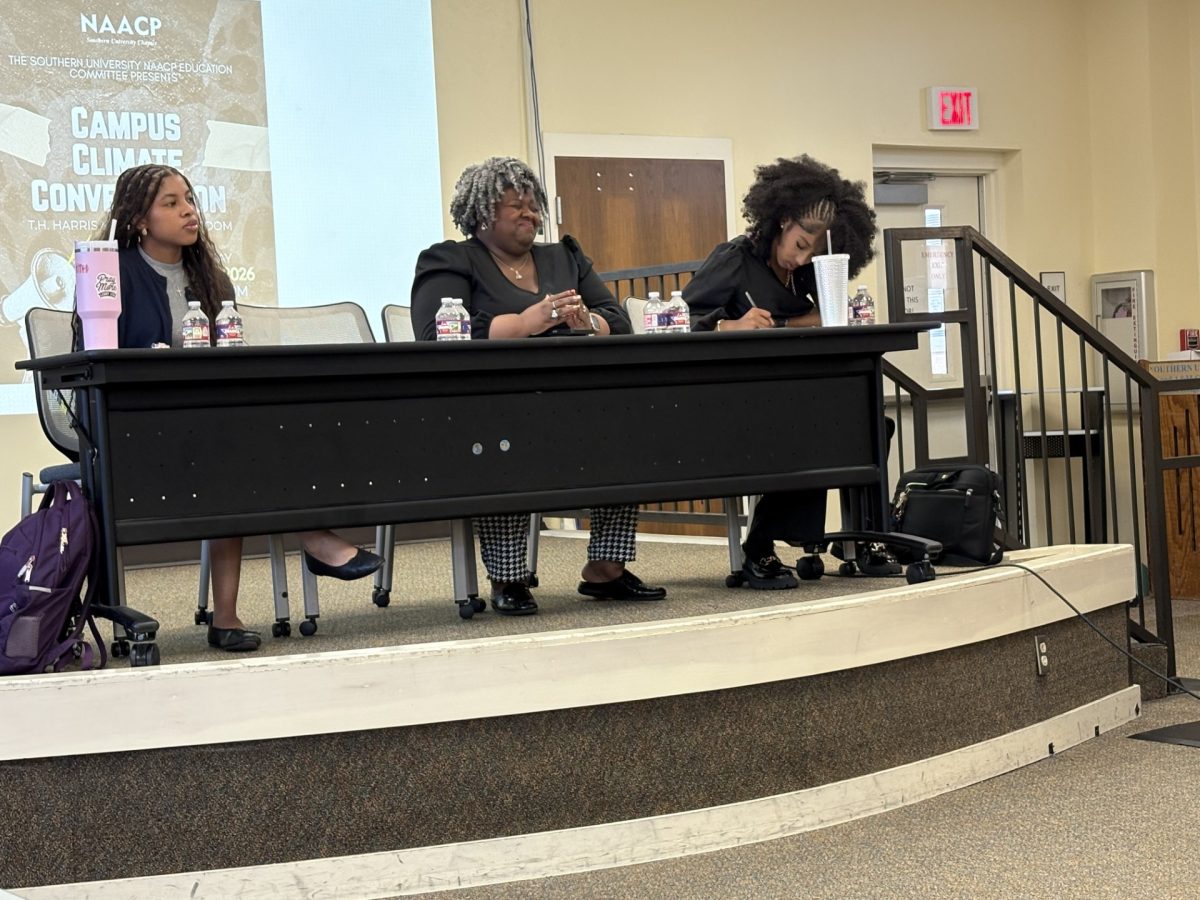
On March 25th, students attended Southern University’s T.H. Harris Multipurpose Room for a Campus Climate Conversation, organized by the NAACP Southern University Chapter’s Education Committee. The goal for this town hall-style event was to hear students’ concerns and questions for the campus leadership and partners.
The panel included Madison Smith, SGA Senator for the College of Agriculture; Kennedy T. Means, member of the LSU Student Government’s Executive Branch, Advocacy Intern at AARP; and Charnel Jackson, Licensed Professional Counselor, Associate Clinical Director of the Southern University Counseling Center, and a specialist in crisis counseling.
Participants reported the issues of campus housing and frequent outages, which were reported to the panelists and caused a lot of frustrations to the students. While panelists defended the importance of their concerns, students emphasized the importance of the accountability of living conditions to continue the dialogue.
Panelists pointed out student activism as catalyzing change, and urged participants to stay active, and continue to communicate concerns through formal channels and campus advocacy groups. The event allowed an open exchange, and students were able to convey specific stories and talk to university representatives in a formalized manner. One of the hot topics of the night was the effect of recurrent blackouts on student life and academic performance.
“Yeah, we need power to do our assignments, and guess what? Our assignments don’t get our extension days and don’t get pushed back. Our assignments are still due tomorrow, that same day, that night day, guess what? Everybody else gets to go home. shut down for the day”
Both panelists and participants shared their impressions about the success of the event and the way to go about it. When asked, “How do you think the event went tonight?” Senior Angelina Lugo responded: “I think that’s this was a great event the turnout was a great. everything was in detail and every panelist answered questions in entirety” In response to the question, Arrynn Adam’s, The Chair of Education, was asked “What did you think the outcome of tonight’s event was?” and shared: “I think this was a great outcome we could have had more people but never considered attending as a entice output but considering how the event went in total”
Organizers described the event as a step toward improving communication between students and campus leadership. While no immediate solutions were finalized, the discussion emphasized the importance of transparency, responsiveness, and continued engagement in addressing campus climate concerns.
The NAACP Education Committee expressed hopes that conversations like this will lead to meaningful change and provide students with a stronger voice in shaping their campus experience.